
This episode of the SmileLine Podcast is brought to you by SmileLine Design. If you’re ready to start your smile restoration journey with permanent, full-teeth dental implants, book your consultation today to discuss your cosmetic dental goals at our Westphalia office near Jefferson City, MO.
Summary:
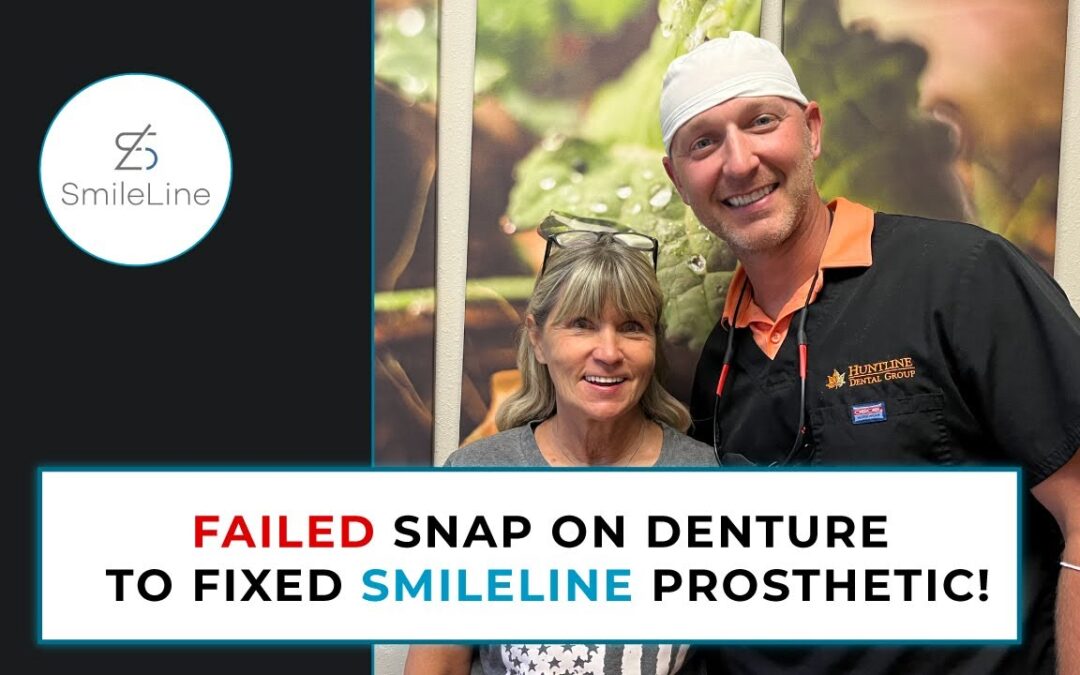
In this episode, Chris Schnieders talks with Veronica about her journey from multiple failed implants and an ill-fitting snap-on overdenture at another office to a stable, fixed SmileLine prosthetic at Huntline Dental near Jefferson City, MO. After Dr. Sam removed poorly placed implants and restored her lower arch with new dental implants, Veronica received same-day temporaries and later her finals—reporting minimal pain, virtually no swelling, and a dramatic improvement in chewing, speech, and confidence. She shares practical tips on hygiene with a water flosser, praises the team’s compassionate care, and encourages others to choose a fixed smile restoration solution even if it costs more, noting the life-changing ability to eat comfortably, smile freely, and brush her “teeth” again.
Chris Schnieders: Welcome to the SmileLine Podcast. The purpose of this podcast is to give real information from doctors and patients about our SmileLine prosthetic and the sequence of appointments. For more information, check out our website or give our office a call. Hope you enjoy today’s episode. All right, guys—welcome back to another episode of our SmileLine Podcast. I’m here with a patient today, Miss Veronica. How are you doing?
Veronica: I’m good.
Chris Schnieders: You were just down for a three-month cleaning, and we thought it was a great time to bring you on the podcast and ask a few questions. You’ve been in your final for a little bit, but I want to take it back to the beginning. You’re a good case to have on because you’ve got a lot of experience, right?
Veronica: Yes, yes, yes.
Chris Schnieders: You originally saw us for a consult in 2022. You were in the middle of treatment at another office, and you’d had implants placed—three of four had failed at that point, I think. Then you came to us seeking advice, right?
Veronica: Yes. I did that prior to this—first time or the second time? I came to Huntline maybe two years ago and decided not to do it because it was too much, you know. And it did not turn out very well.
Chris Schnieders: It didn’t turn out.
Veronica: So I went back to them. They placed new implants.
Chris Schnieders: Yes?
Veronica: I have had three implants fail three different times.
Chris Schnieders: Three implants fail three different times?
Veronica: Three different times. Yeah.
Chris Schnieders: That’s a terrible experience.
Veronica: It is. I’ve had one dentist where I was in the chair and he called another dentist over and said, “Hey, come here, look at this.”
Chris Schnieders: That’s never good when you’re sitting there, huh?
Veronica: No, no, no. I thought it was broken or something.
Chris Schnieders: We saw you again at the beginning of 2024. Dr. Sam looked at your implants, saw where they had failed, and your prosthetic at the time was a snap-on overdenture, right?
Veronica: Yeah.
Chris Schnieders: That’s where you place implants and the denture snaps on to little O-rings on the bottom.
Veronica: Correct. They never did snap in all the way correctly from day one.
Chris Schnieders: We consulted and showed you our SmileLine—the fixed prosthetic that doesn’t come out. We actually no longer do snap-on overdentures and haven’t for a while. A lot of the reasons you were having issues—higher chance of implant failure, more maintenance, and not meeting expectations consistently—are why we stopped doing them. Unfortunately, you went through that with another office: the pain and suffering.
Veronica: Yes. I’ve left the dentist before in the past crying. I mean crying—bawling crying.
Chris Schnieders: Just not Huntline though, right?
Veronica: No—well, yes I did, but it was out of pure—
Chris Schnieders: Happy tears. We like those! We like those. So we saw you for a consult. Dr. Sam looked at the existing implants and determined they weren’t placed where he’d like, so we removed those and placed new implants in your lower. How was that surgery process?
Veronica: It wasn’t bad—considering I wasn’t put under. The only bad part was keeping my mouth open for so long. That was my only complaint. Nothing else hurt. I wasn’t uncomfortable except for my jaw.
Chris Schnieders: That’s what we hear a lot—“I wasn’t in pain, just tired of holding my jaw open.” Surgery went fine, and then we got you in a temp the same day. How did you like the look of your first temp?
Veronica: It was fine. I think it broke off a little, and he did say it was close, but it did break a bit. I wasn’t too worried—still ecstatic with what I had. It was still better than my overdenture.
Chris Schnieders: During these cases we do surgery and deliver a same-day temporary fixed prosthetic—3D printed in dental resin. It usually holds up great. One or two out of ten have issues where we retighten or a piece breaks. If it breaks up front, we reprint; if it’s in back and tolerable, we move you to finals as soon as possible. It’s really a hold-over so you have fixed teeth and so we can verify tooth position for your final.
Veronica: Right. Mine broke, but it didn’t cause problems. No sharp edges—my tongue didn’t suffer.
Chris Schnieders: Good. And we also discussed making a new upper denture.
Veronica: Not yet. I’m going to do the same for the top soon.
Chris Schnieders: Got it—we matched the lower with your current upper denture. On delivery of the final, we actually had this podcast scheduled that day, but it took a little extra time and we let you head home. It was a long appointment. Everything isn’t always roses—I don’t want to convince patients it goes 100% perfectly every time. How was that delivery?
Veronica: I was there a long time. My husband was with me. It wasn’t horrible. There was downtime because of the printing process, but we’ve got games on our phones now, so we don’t have to just sit and twiddle our thumbs. It was just long—not painful.
Chris Schnieders: The last couple patients I had on were same-day finals, so they hadn’t really worn them yet. You have. How do you like your final?
Veronica: I love them. I can eat better. I can bite into things, and I don’t have to worry about them coming out. Before, if I opened my mouth really wide, my teeth would flop out. I’m very self-conscious about that kind of thing. One of my biggest fears was losing my teeth. I couldn’t be happier. I should’ve done this a long time ago—but everything happens for a reason.
Chris Schnieders: We hear that a lot—“I wish I’d done this sooner.” And Dr. Sam’s explanation made sense?
Veronica: Yes—especially to my husband. He used the fence analogy—he explained it really well.
Chris Schnieders: Sam likes those farming and construction analogies.
Veronica: My husband’s a farmer, so it resonated.
Chris Schnieders: Tell me about your diet—week of surgery, temporary, then final.
Veronica: In the beginning it was a soft diet. In the past it was Jell-O and that kind of thing, but this time I could eat Hamburger Helper—soft foods, not just pudding and Jell-O.
Chris Schnieders: You went to Hamburger Helper right after surgery?
Veronica: I ate it that night.
Chris Schnieders: Good. It can be a little scary when something gets underneath there.
Veronica: Yes, but using my water pick and the tools I have to clean under there, it’s not a big deal anymore. I like to keep them clean—even though they’re not my real teeth and I won’t get cavities, there are still holes down there. I still think I have to clean really well.
Chris Schnieders: Absolutely. You won’t get decay on the prosthetic, but buildup around implants can lead to bone loss and increase implant-failure risk.
Veronica: I’m not risking that. I’ve been through it—I don’t want it again.
Chris Schnieders: Back to diet—any restrictions now?
Veronica: Because of my tops, I still can’t eat some things. But I did eat a filet, and I could chew it right. I hadn’t had steak—if I did before, I couldn’t chew it all the way or break it off. I can eat steak now—has to be a filet, a little soft. Don’t leave it on too long and make it tough.
Chris Schnieders: I like filets better anyway. So the only restriction is your upper denture—nothing on the lower?
Veronica: Yeah. I’d love to bite into an apple.
Chris Schnieders: One day—maybe we’ll get those uppers fixed in place. How about pain, swelling, bruising after surgery? I get those questions a lot.
Veronica: Night and day compared to the other office. I bruised and swelled up big before—horrible. I have pictures—people didn’t recognize me. After the first time at the other office, the pain was so intense I swore I’d never do it again. This last time, I was off pain meds within three days and on ibuprofen—hardly any pain.
Chris Schnieders: And bruising or swelling this time?
Veronica: I don’t think I had any. I didn’t notice any.
Chris Schnieders: It varies patient to patient, and people worry—how long do I have to stay home? For you it was about three days of babying it?
Veronica: Yes—about three days. That was just me babying it.
Chris Schnieders: How’s the process of cleaning underneath? Have you made it a routine?
Veronica: After today it’ll be easier—she adjusted them. I had trouble getting floss sticks into one area, but they go in fine now. If you’re a little OCD, it’s kind of rewarding. I have a water pick—the water pick comes with a toothbrush—and I can brush my teeth again. Now I’m going to start crying. It’s amazing to brush my teeth again.
Chris Schnieders: That’s awesome to hear. We put access holes where we can—we don’t want to remove too much. Once we try them in and get feedback, it’s normal for us to smooth a bit more so you can access those spots. It makes it more convenient.
Veronica: I can feel a little more air through there too.
Chris Schnieders: You’ve experienced another office that placed implants—with swelling, pain, and failures—and then your experience here at Huntline. How’s the staff been?
Veronica: I was just thinking that. Before, at the first dentist, being a farmer, I felt like cattle being run through. I really did. I don’t feel that way at all now. I feel like they know me, know I’m coming from a long way. The first couple times I got here, I had to go to the bathroom really bad from the drive, and every time I come in now she says, “If you need the bathroom, it’s right up there.”
Chris Schnieders: Sheila’s pretty accommodating up front.
Veronica: Yes. I feel like the ones I’ve seen remember me—and that’s important.
Chris Schnieders: Very important. We treat a lot of patients, but you don’t forget faces—we see you enough to build a relationship. Do you have any advice for patients considering treatment?
Veronica: I’d say do it. It is pricier, but so worth it. You can’t put a price on brushing your teeth again, or eating food without worrying about your teeth falling out. I even talk better—there isn’t all that plastic underneath. It’s so worth it.
Chris Schnieders: You touched on a great point—speech. In consults I show patients the volumetric size of our prosthetics—they’re much slimmer and smaller than overdentures or conventional dentures. No big flanges, not as bulky—feels more natural.
Veronica: I was constantly asking them to file it down—make it paper-thin.
Chris Schnieders: Veronica, thank you for joining me on the SmileLine Podcast. We’ll see you in another six months for a cleaning.
Veronica: Yep, it was my pleasure.
Chris Schnieders: Thank you!
Thank you for listening to this episode of the SmileLine Podcast. Inspired by Veronica’s permanent dental replacement results? Visit SmileLineDesign.com to schedule your consultation today.